When Did Vegan Become a Dirty Word?
The waiter came around the table, and I ordered the barbecue chicken.
My wife Bridget laughed and told him I was kidding.
I wasn't. Seven years of no animal products, and it ended in the time it took to scan a menu and decide I wanted something. There was no revelation. No collapse of principle. I just wanted the chicken.
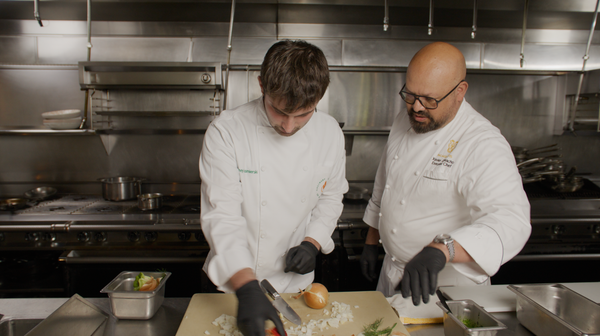
The reason that moment landed so hard for her is that she had earned a say in it. When I started at Rouxbe, the first course I took was Culinary Rx, and it genuinely changed how I looked at food. I made a fast decision to go vegan, much to Bridget's chagrin. For four years she cooked two dinners a night. Not because she agreed with me. Because she loved me, and because that is what she decided support looked like. There is no vegan documentary on earth with a hero as good as that.
A word with a birth certificate
Vegan is not a slur, though you would not know it from how the word lands in a room. It has a documented origin, and a gentle one. In 1944 a British woodworker named Donald Watson took the first three letters of "vegetarian" and the last two, stitched them together, and founded the Vegan Society. It was a philosophy first and a grocery list second.
"Plant-based" is the younger, blander cousin, and blandness is the point. The term is generally associated with nutrition researcher T. Colin Campbell, who needed language for a diet built on whole plants that would not drag a moral argument into a research paper. Plant-based describes a plate. Vegan describes a worldview. One is something you eat. The other is something you are.
That difference matters, because nobody has ever been accused of hypocrisy over a plate. A worldview can be audited. A worldview owns leather boots. A worldview once ate a scallop in 2011 and somebody at the table remembers.
So people quietly rebranded. Same broccoli, different paperwork. Say "I eat mostly plant-based" and you remain a citizen in good standing. Say "I'm vegan" and you have been enrolled, without consent, in a debate club you never joined, against an opponent who has been preparing his opening statement since the appetizers arrived. He would like to know where you get your protein. He has never once asked the man on his third dinner roll where he gets his fiber. That would be rude.
What we are actually arguing about
Almost none of it is nutrition. If it were nutrition, the argument would have ended years ago in a very boring consensus about vegetables, fiber and portion size, and we could all go back to talking about anything else.
Food became identity, and identity became content.
Meat picked up a set of associations somewhere along the way: strength, tradition, provision, the authority of fire. No advertisement in history has shown a man building a deck while eating chickpeas, and that is a failure of casting, not agriculture. Salad, meanwhile, got assigned the role of punishment, which is remarkable when you consider that salad is mostly just other food wearing a hat.
Then wellness culture arrived and made the opposite pole equally insufferable, selling an eighteen-dollar green juice that does not contain eighteen dollars of anything. What you are buying is absolution, and absolution has never been cheap. Somewhere in the middle sits an actual bag of lentils, two dollars, saying nothing, judging no one.
Which produces the sneakiest myth of all, that eating plants is a luxury. Tell that to the world's great thrift cuisines. Rice and beans. Dal and flatbread. Injera and stewed greens. Pasta e fagioli. Some of the most plant-forward cooking on the planet was invented by people who could not afford to waste anything, and it is still better than most of what gets photographed.
Meanwhile the algorithm rewards only the extremes. The raw vegan and the carnivore influencer eating butter directly off the stick are locked in a mutually profitable arrangement, each supplying the other with daily proof that the opposition has lost its mind. Honestly, they should be splitting the revenue. The rest of us, the overwhelming majority who want dinner and possibly a second helping, do not trend. Reasonable people eating a reasonable amount of food is not content. It is just Tuesday.
The cost of the joke
"How do you know someone's vegan? Don't worry, they'll tell you."
Funny the first time. Possibly the fourth. It is usually delivered by a man who has described his smoker to me in a level of detail I would characterize as load-bearing.
But the joke does quiet work. It teaches people that stating a preference is an imposition, and once that lesson lands it spreads well past veganism. It is why someone accepts a dish they cannot safely eat rather than make a fuss. Why a guest pushes food around a plate instead of saying a word.
You almost never see the reason across a table. A doctor's instruction after a scare nobody discussed publicly. A faith tradition. A grandmother's recipes carried forward on purpose. A budget doing its best. An athlete chasing a specific outcome. Or someone who just likes vegetables, which remains legal in all fifty states.
Everyone at that table made choices today too. Yours just did not require an announcement.
Being your own scientist
Here is the part that complicates my own story, and I am including it because leaving it out would make this essay dishonest.
Those seven years, I felt healthier. And in the four years after that chicken, eating widely and still believing I was choosing well, I gained substantial weight and topped out at 232 pounds on a five-foot eleven frame. The bloodwork was worse than the scale. My doctor and I have spent the last four months undoing it, and I am down 45 pounds from the peak.
So what was the villain? Not the chicken. Not the lentils either. It was portion size, activity, and eleven years of assuming a label was doing the work that attention was supposed to do. Both diets can be excellent. Both can be a mess. The label never once checked in on how I was actually doing.
What worked was paying attention. Knowing my own body, watching my own numbers, and adjusting based on what I saw rather than what a category promised me. Sometimes you have to be your own scientist. Run your own trial, read your own results, and be brave enough to act on them, including when the results contradict something you announced at a dinner party seven years ago.
The table is big enough
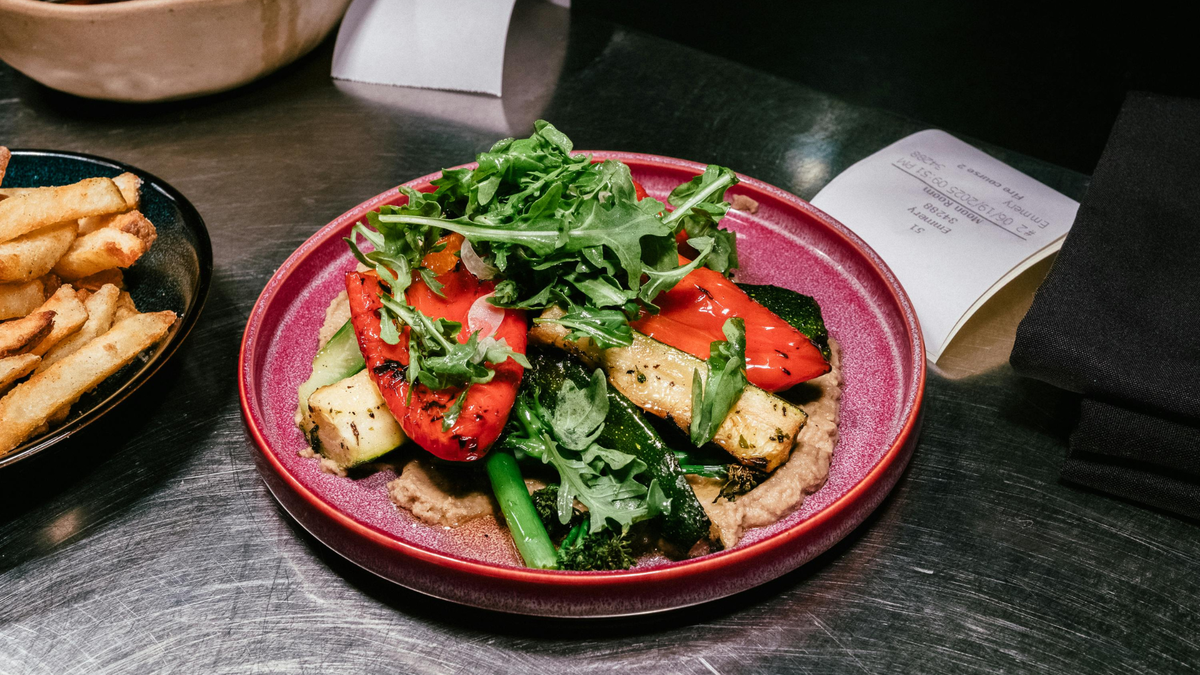
Cooks understood this before anyone. A patient sear, a stock built properly, an onion cooked well past the point you thought it was done, cabbage roasted until the edges go dark and sweet. Salt, acid, heat and patience are agnostic. The knife skills transfer.
I get to watch this play out at work. Rouxbe teaches professional plant-based cooking and classical technique in the same school, to the same students, and the interesting thing is how rarely anyone finds that strange. A cook learning to build a vegetable stock with real depth is learning the same lesson as a cook learning to break down a chicken: pay attention, respect the ingredient, do not skip the slow part. Our students arrive as vegans and ranchers and hospital dietitians and line cooks, and the curriculum does not ask them to declare a side. It asks whether the dish is good. That question never needed a tribe to answer it.
Because nobody has ever been lectured into a lasting change. People change when the food is good, and when someone hands them a bowl of something and they think, with no ideology attached, I would like that again.
So order the steak. Order the lentils. Order the barbecue chicken, even if the whole table thinks you are kidding.
And if you must ask a question at dinner, try this one: what did you eat this week that was really good?
You will get a better answer. You will get a better evening.